When I took on my first fractional CFO engagement, the operational question wasn’t "what’s the right reporting cadence?" or "how do we close the month?" It was much more boring: how do I see what this company is actually spending, in close to real time, without spending half my week chasing receipts and asking the founder to forward me Amex statements?
Ramp solved that for me on day one. Two years and several engagements later, it’s the first tool I implement when a new client is willing to switch. But the reason it’s stuck — and the reason I tell other fractionals to lean in rather than dabble — is that the value compounds when you actually use every feature. Cards, Bill Pay, Reimbursements, Travel, Procurement, Treasury, the API. You don’t get the magic from any one of them. You get it from the fact that, once it’s all turned on, expenses can’t escape.
That’s the mental model I want to walk through.
The funnel: nothing leaves the platform
Most companies, especially seed-stage and lower-middle-market, have spend leaking in five or six directions. Cards on Amex, vendor payments via the bank’s clunky bill pay portal, reimbursements as Venmo screenshots, travel booked on whatever site had the cheapest flight, SaaS renewals nobody is tracking, and a treasury account at a separate bank that the founder logs into once a quarter. Every one of those is a hole in the bucket. Every one is a place where a transaction can occur that I, as the CFO, won’t see until the month-end statement lands.
When I roll out Ramp, the whole point is to close those holes one at a time until there are no holes left. Cards go on Ramp. Vendor bills route through Ramp Bill Pay. Employee reimbursements run through Ramp. Travel gets booked on Ramp Travel so the spend is pre-coded and policy-checked before it hits a card. Procurement requests get logged in Ramp before anyone signs a contract. And — this is the part I want to spend more time on — operating cash sits in Ramp Treasury.
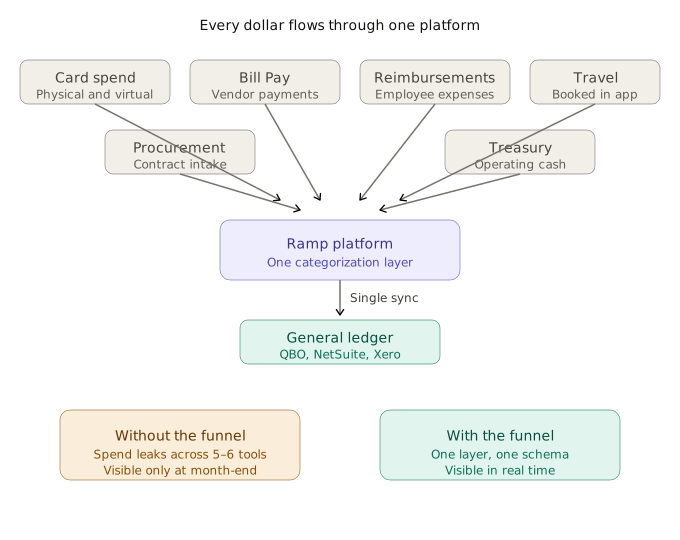
Once that’s done, the platform becomes a funnel. Every dollar of spend, regardless of how it gets initiated, passes through one categorization layer, one approval layer, one receipt-capture layer, one GL-mapping layer, one sync to QBO. There’s no "wait, where did that $4,200 come from" anymore. If it happened, it’s in Ramp. If it’s in Ramp, it’s coded. If it’s coded, it’s already in the books.
That’s the inversion most founders don’t understand until they live it. It’s not that any single feature is dramatically better than its standalone competitor. It’s that the integration tax — the cost of stitching seven point solutions together — goes to zero.
Treasury is the piece that makes the funnel actually work
Cards-only Ramp is fine. Cards plus Bill Pay is good. But the platform doesn’t become *closed* until the operating cash itself lives inside it. That’s why Treasury is the feature I push hardest on, even though it’s the one founders are usually slowest to adopt.
Here’s how I think about it, and how I deploy it.
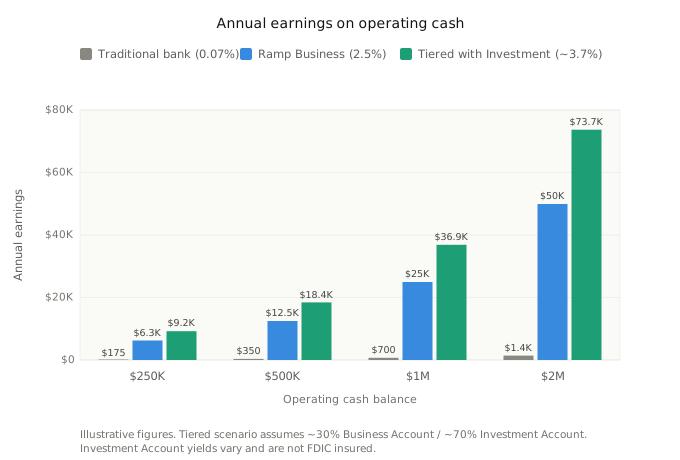
The Business Account is the operating hub. Ramp Business Account is a deposit account through First Internet Bank of Indiana, currently earning 2.5% on operating cash, with FDIC insurance and instant liquidity for bill payments. That’s roughly 35x what a traditional business checking account pays, on cash you were going to keep liquid anyway. For a client with $500K–$2M sitting in operating cash, that’s real money — somewhere in the range of $12K–$50K a year of earnings the company was previously leaving on the table at their regional bank.
But the yield isn’t actually why I push it. The yield is the bait. What I’m really after is having the operating account inside the same platform as the spend.
The Investment Account is where excess cash works harder. For cash beyond the working-capital buffer, Ramp’s Managed Investment Account, run by Moment Advisors, is a clean way to pick up additional yield without the founder having to manage a brokerage relationship. It invests in short-duration, investment-grade fixed income — short-term U.S. Treasuries, money market instruments, and short-duration investment-grade corporate bonds. For an early-stage client, I’m not putting payroll cash in there. I’m using it for the runway buffer that doesn’t need to be liquid this week — typically the chunk between three months of burn and twelve months of burn.
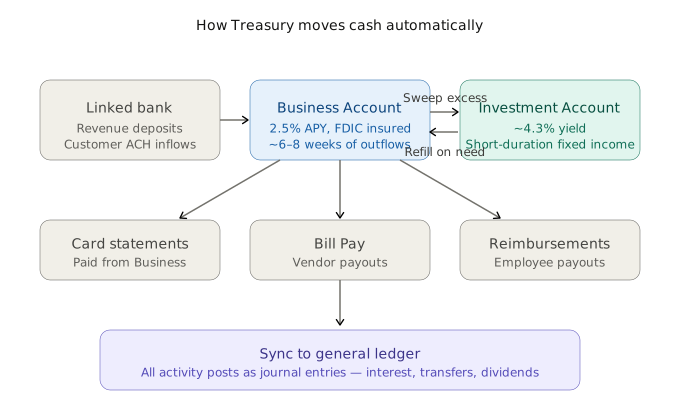
Sweep automations remove the human judgment call. This is the feature that actually changes my life. A sweep automation moves any cash above a set threshold from the Business Account to the Investment Account, optimizing yield without manual transfers. I configure a minimum operating balance — enough to cover roughly six to eight weeks of cash outflows — and anything above that automatically gets swept to the higher-yield account. When a bill goes out and the balance drops, a target balance automation pulls cash back from the linked bank or from investments to refill. The CEO doesn’t have to think about it. I don’t have to log in weekly to move money. The optimization runs itself.
Liquidity forecasting closes the loop with FP&A. Ramp surfaces cash shortfall alerts and shows projected balance against upcoming card statements, bill payments, and reimbursements. For a fractional CFO, this is the piece I’d otherwise be hand-building in Excel for every client. Instead I can look at one screen and see, in dollar terms, whether the client has a liquidity event coming in 30/60/90 days. That’s the conversation I want to be having with the founder, and Ramp is the substrate that makes it cheap to have.
The accounting sync ties it all back together. Treasury activity — deposits, withdrawals, monthly earnings payouts, buy/sell orders, dividends — syncs as journal entries directly to QBO, NetSuite, Xero, or Sage Intacct. Monthly statements give me clean tie-outs at month-end. So the cash side of the close, which historically was the slowest part for me, is effectively pre-built by the time I sit down to look at it. The interest income is booked. The transfers between accounts are eliminated. The investment activity is journalized. I’m reviewing, not building.
For clients on the larger end, there’s also a Ramp Operating Account that uses a pooled structure with sub-ledgered balances and FDIC pass-through coverage — relevant if a client needs to hold more than the standard $250K of insured cash. I haven’t deployed it widely yet, but it’s in the toolkit.
The setup I run for clients
For a seed-stage client, the rollout is pretty standardized. Issue physical cards to the founders and any ops lead, virtual cards for every recurring vendor, and a separate virtual card per major SaaS contract so I can see renewal risk at a glance. Then Bill Pay gets configured against the GL vendor list. Reimbursements get policy-tuned. Travel gets enabled with the company’s per-trip caps. Procurement gets turned on for anything above a threshold so new contracts can’t get signed without an intake. Treasury accounts get opened and sweep automations get configured against forecasted burn. From there:
- Categories and GL mapping get configured to match the client’s chart of accounts. This is the unglamorous step that makes everything downstream work.
- Policies are tuned to the company’s stage. For a 10-person company, I’d rather set a sensible per-transaction limit and let the team move than gate everything behind approvals. For anything over a threshold or anything new-vendor, the policy routes it to the founder for sign-off.
- Receipts are required at the transaction level, with the Ramp mobile app or email forwarding doing the capture. Memo fields get used like a free-text GL — "client dinner: vendor renewal" — which pays off later when I’m building the variance commentary.
- Treasury automations get sized off the cash forecast. Minimum operating balance covers near-term outflows with a margin; everything above sweeps to investment.
That’s the boring part. The interesting part is what it enables.
Where it actually pays off
1. Month-end close gets faster, in a way I can measure.
Ramp-to-GL reconciliation used to be the gating item for close. Now it’s not. Coding happens at the point of swipe — by the cardholder, with rules I’ve set — so by the time I sit down to reconcile, 85–90% of the transactions are already in the right account with the right class. Add in Treasury journal entries syncing automatically, and the cash side of the close is essentially pre-built. The remaining 10–15% is where I add value anyway: judgment calls on capitalization, reclassifications, prepaid amortization. That’s exactly the inversion you want as a fractional. The robot handles the volume; I handle the judgment.
2. Real-time spend and cash visibility changes the conversation with the founder.
When I get on a call with a CEO, I’m not telling them what they spent six weeks ago. I’m telling them what they spent yesterday, what’s trending against budget for the current month, where the next renewal pressure is, and how many days of runway they actually have given current cash and the next 60 days of outflows. That changes the meeting from a postmortem to a planning session. It’s the single biggest reason founders feel like they actually have a CFO function and not just a bookkeeper with extra steps.
3. Vendor consolidation pays for itself.
Ramp’s vendor dashboard surfaces overlapping subscriptions, dormant tools, and price increases. For a typical seed-stage client I’ve found 10–20% of SaaS spend that was either duplicative or unused. That’s real money, and it’s the kind of finding that makes a fractional engagement obviously ROI-positive in month one.
4. The card and policy controls let me delegate without losing sleep.
The thing I want least is to be the bottleneck on a $200 software purchase. Per-card limits, vendor-locked virtual cards, category restrictions, and procurement intake mean I can give the team real autonomy without exposure. If someone tries to charge a personal Uber to a card locked to AWS, the transaction just doesn’t go through. The control is upstream of the behavior, not downstream as a policy violation email.
5. Treasury yield plus sweep automations move actual money to the bottom line.
This is the one I have to remind founders is real. A company with $1.5M in operating cash, properly tiered between Business Account and Investment Account with a sweep automation, will pick up tens of thousands of dollars a year in earnings versus leaving the cash in a traditional business checking account. That’s not a strategic move — it’s free money that was sitting there. For a venture-backed company, that’s runway extension at zero risk and zero operational cost.
6. The API and MCP layer is where it gets fun.
This is the part most fractional CFOs don’t talk about yet, but it’s where I think the role is going. Ramp’s MCP server lets me wire spend and treasury data directly into the agentic close pipeline I’m building. I can ask Claude to pull all transactions over a threshold for a given period, cross-reference against budget, pull current treasury balances and forecasted cash position, draft the variance commentary, and queue up journal entry adjustments — all without me opening a spreadsheet. The data is structured, the API is sane, and the auth model is straightforward enough that I can run it across multiple client tenants without losing my mind. The funnel I described at the top of this post is also the thing that makes the agentic layer tractable: one source of truth, one schema, one API surface.
What I’d tell another fractional considering it
A few honest caveats. Ramp isn’t free in a real sense — you’re not paying a card fee, but you’re trading some flexibility you’d get from a traditional Amex relationship (rewards optimization, specific airline status). For most seed and Series A clients, that trade is obviously correct.
The Bill Pay product is good but not best-in-class for complex AP workflows. If a client has 200+ vendors with bespoke payment terms, I’ll sometimes pair Ramp with a dedicated AP tool. Most don’t, and the integrated workflow wins.
On Treasury specifically: the Investment Account isn’t FDIC-insured (it’s a brokerage account holding government money market and short-duration fixed income), so the conversation with the founder needs to be honest about that. The risk is low but not zero, and the suitability question matters. I don’t put cash a client needs for next month’s payroll into the Investment Account; I put cash they won’t need for 90+ days.
And the GL sync, while solid, still needs a human reviewing the mapping for the first 60 days. Categories drift, new vendors appear, and the AI categorization is good but not perfect. Plan for that.
The bigger point
The reason I keep choosing Ramp isn’t really about cards, or yield, or even AP. It’s that running every feature creates a closed system where spend and cash can’t go undetected, miscategorized, or unproductive. The funnel is the product. Cards alone is a corporate card with nice software. Cards plus Bill Pay plus Reimbursements plus Travel plus Procurement plus Treasury, all syncing into the same GL, is an actual finance operating system.
For a fractional CFO working across multiple companies in a week, that compounding matters. Every hour I don’t spend on data hygiene is an hour I can spend on the model, the strategy conversation, or the next build. And the closed system is also what makes the next layer — Claude, MCP, agentic close workflows — actually feasible. You can’t automate what you can’t see.
If you’re running a fractional practice and still asking founders to forward you Amex statements, you’re leaving leverage on the table. Get the spend platform right, turn on every module, move the cash in, and then everything else gets easier.